Teaching the Alphabet at Home with the BASICS App
By Wellness Hub
Last Updated: February 10, 2024
A playful, practical path to letter names, shapes and sounds—with guided alphabet games in the BASICS app.
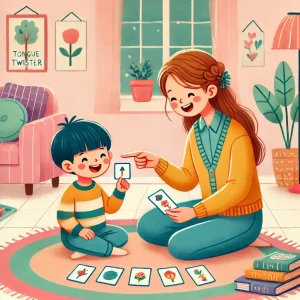
Learning the alphabet is an important early step towards reading and writing, but it does not need to feel like a lesson or a test. Young children can explore letters through songs, stories, movement, hands-on play and short moments of direct teaching. This guide explains how to teach the alphabet at home while following your child’s pace, with the BASICS app providing guided opportunities to practise.
To teach the alphabet at home, introduce a few letters at a time, say each letter’s name and common sound, and connect it with meaningful words. Practise through songs, letter hunts, books and hands-on play. Short, repeated sessions—including guided games in BASICS—are more useful than expecting a child to memorise all 26 letters at once.
Every child develops early literacy skills at a different pace. Some become interested in letters early; others are more interested in stories, pictures or spoken words first. The aim is not to rush a child into formal reading. It is to help letters become familiar, meaningful and enjoyable while building the knowledge that later reading instruction will use.
Letters Have Names and Represent Sounds
A letter has a name, a written shape and one or more sounds it can represent in words. For example, the letter B is called “bee” and commonly represents the sound /b/ at the beginning of ball. The relationship is not always one letter to one sound: c sounds different in cat and city, and letter groups such as sh can represent one sound.
Children benefit from learning letter names and common letter sounds together. Letter names help them talk about print, while letter-sound knowledge helps them connect written letters with spoken words. Neither needs to be treated as more important than the other.
When modelling a consonant sound, keep it short and clear. Say /b/, not “buh,” and /m/, not “muh.” Adding an extra “uh” can make it harder to blend sounds later. For example, the sounds /s/ /ă/ /t/ blend to make sat; the spoken letter names “ess-ay-tee” do not.
Phonics is the teaching of relationships between sounds and written letters or letter groups. It is one part of learning to read. Children also need rich spoken language, shared reading, vocabulary, awareness of sounds in spoken words and, when they are ready, systematic instruction in blending and decoding.
Letter knowledge becomes useful when a child can recognise a letter in different places, name it or identify a common sound, and connect it with real words—not only recite the alphabet song.
Where to Start When Teaching Letters at Home
You do not have to teach all 26 letters in alphabetical order. A simple, organised starting plan is easier for both you and your child:
- Begin with one or two meaningful letters, such as the first letter in your child’s name.
- Introduce a small group of visually different letters rather than similar pairs such as b and d together.
- Teach the letter’s name, show its uppercase and lowercase forms, and model its most common sound.
- Add useful consonants and vowels that can later form simple words. A set such as s, a, t, p, i, n is one possible example, not a required order.
- Mix new learning with quick review so previously introduced letters stay familiar.
- Revisit the same letters in books, signs, labels, drawings and play.
Meaning helps a child pay attention. The M in their name, the B on a favourite book or the S on a shop sign gives an abstract symbol a purpose. Once a few letters are familiar, gradually add new ones rather than presenting the whole alphabet at once.
Playful Ways to Teach Letters
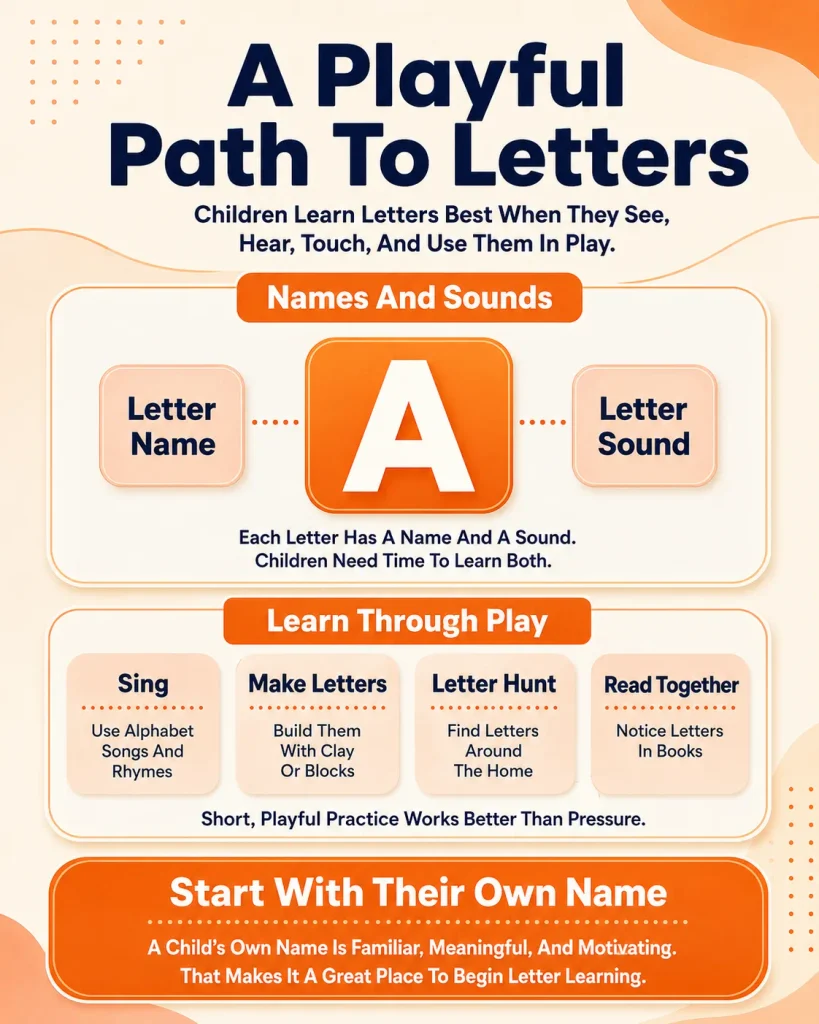
Play makes practice inviting, while clear adult modelling helps a child notice exactly what to learn. These alphabet activities for kids combine both.
1. Sing the Alphabet—and More
The alphabet song helps children remember the conventional letter sequence. Slow it down around “L-M-N-O-P” so the letter names do not blur together, and occasionally pause to let your child supply the next letter.
The song alone does not teach a child to recognise letters out of order. Pair it with a small set of letter cards or magnetic letters. After singing, choose one letter and say, “This is M. Its common sound is /m/, as in moon.” Keep the sound clipped rather than adding “uh.”
Songs and rhymes that draw attention to the first sound in words can also support listening. Ask, “Do moon and milk start with the same sound?” without turning every song into a quiz.
2. Make Letters Hands-On and Sensory
Build letters with playdough, draw them in sand, make them from sticks or trace a large letter with a finger. These activities can support engagement and help children notice a letter’s lines, curves and direction.
Model the movement clearly. You might say, “Start at the top and go down,” while forming a lowercase l. Use the same verbal cue each time, but allow your child to watch before expecting them to copy.
Sensory play is optional. A child who dislikes sticky, wet or grainy textures can use dry-erase boards, chunky magnetic letters, paper, blocks or a finger moving through the air. The purpose is letter exploration, not tolerating an uncomfortable material.
3. Go on a Letter Hunt
Choose one familiar letter and look for it in a book, on packaging or on signs. Begin with an easy target: “Can we find the A in your name?” When your child finds it, name the letter and, when appropriate, its common sound.
Keep the search focused. Hunting for one or two letters is usually more manageable than asking a beginner to identify anything they see. Point out that the same letter may look different in uppercase, lowercase and different typefaces.
You can also sort letters into simple groups: letters in the child’s name, letters with curves, or matching uppercase and lowercase pairs. Avoid speed competitions, especially while a letter is new.
4. Read Together
Shared reading supports vocabulary, spoken language, story understanding and awareness of print. It also creates natural opportunities to notice letters without interrupting the story on every page.
Before or after reading, point to one familiar letter in the title: “This is T. It is the first letter in tiger.” Invite your child to find it again, but continue reading if they are more interested in the story. Enjoying and understanding the book remains valuable.
Alphabet books can be useful, but they are not essential. A favourite story, a name card or a cereal box can all provide meaningful print. Shared reading complements direct letter and phonics teaching; it does not replace it.
5. Connect Letters to Sounds and Words
Choose a letter, model its common sound and connect it with a few familiar words: “B commonly represents /b/, as in ball, bag and banana.” Ask your child to listen for the first sound rather than guess from a picture alone.
Use objects when possible. Place a ball, cup and banana on the table and ask which two begin with /b/. If this is difficult, say the words slowly and emphasise the first sound. You can also reverse the task: show B, make /b/ and ask your child to choose an object that begins with that sound.
Start with common, easy-to-hear sounds. Save unusual examples and complex rules for later. The goal is not to teach every possible sound for a letter at once, but to build a reliable first connection that future phonics teaching can expand.
Follow Your Child’s Pace and Interest
A few focused minutes can be enough for a young learner. Stop while the interaction is still comfortable, return to the same letters over several days and introduce new letters gradually. Some children enjoy saying an answer; others may prefer pointing, matching, signing, selecting a picture or using AAC. All of these responses can show participation and understanding.
Praise specific effort: “You looked carefully and found the M,” or “You heard /s/ at the start of sun.” This tells your child what strategy worked. Avoid testing repeatedly, comparing them with another child or withholding play until they give a correct answer.
Children aged two are not all ready for formal alphabet instruction simply because an app serves a wider age range. Follow your child’s communication, attention and interest. Songs, conversation, stories and play remain worthwhile even before a child begins identifying letters.
If a child becomes frustrated, reduce the number of choices, demonstrate the answer and finish with something familiar. Repetition is useful; pressure is not.
Common Questions Parents Ask
Should I Teach Capital or Lowercase Letters First?
Children need both. Lowercase letters appear more often in books, while uppercase letters are sometimes easier to distinguish and may be familiar from a child’s name. Teach a manageable mix and connect the two forms: “This is uppercase A, and this is lowercase a. They have the same name.”
Start with forms that are meaningful and visually clear. You do not need to master all uppercase letters before showing lowercase ones, or the reverse.
My Child Knows the Alphabet Song but Cannot Recognise the Letters. Is That Normal?
Yes. Singing a memorised sequence and recognising individual printed letters are different skills. Continue enjoying the song, then work with two or three letters outside alphabetical order. Ask your child to match identical letters, find a named letter or connect a familiar letter with its common sound.
Begin with letters from their name or favourite words. This gives the symbol meaning and makes recognition easier to practise in daily life.
My Child Mixes Up Similar Letters Such as b and d. Should I Worry?
Confusing visually similar letters can be common while letter knowledge is developing. Avoid introducing several easily confused letters at the same time. Teach each one clearly, use a consistent formation cue and compare them only after each is more familiar.
A reversal by itself does not diagnose a reading difficulty. If confusion persists as your child gets older, or occurs alongside difficulty learning letter sounds, blending sounds or making expected reading progress, speak with their teacher, a reading specialist or another qualified professional. Early support can clarify what your child needs.
How the BASICS App Helps You Teach Letters
The BASICS app includes Academic games involving letters and letter sounds. These games can give your child short, guided opportunities to practise while you observe what is familiar and what still needs support. Use the app as one part of a broader routine that includes conversation, books, movement, drawing and real-world print.
Letter-Recognition Games
Letter-recognition games can help children attend to letter shapes and distinguish one symbol from another. Sit with your child when possible. Name the target letter, allow time to respond and model the answer without criticism if they are unsure.
After playing, look for the same letter away from the screen. Find it in your child’s name, make it with blocks or circle it on a printed page. This helps connect a game response with letters used in everyday life.
Letter-Sound Practice
BASICS can provide practice connecting letters with common sounds. Model sounds accurately and briefly, without adding an extra “uh” to consonants. If the game presents M, for example, say /m/ and connect it with a familiar word such as mummy or moon.
A child may recognise a correct response in a game before using the skill independently in a book or writing task. Treat app performance as practice, not proof that a skill is fully mastered. Revisit the same connection through speech, objects and print.
Connect App Practice to Books and Everyday Print
The strongest use of an alphabet game is as a starting point for interaction. After a short BASICS activity, choose one letter to carry into the day:
- find it on a food packet or street sign;
- match uppercase and lowercase versions;
- say its name and common sound;
- build or draw its shape;
- find an object whose name begins with that sound.
These small follow-up activities make practice concrete and give you a chance to adjust the challenge. If your child finds an activity difficult, reduce the choices or model it. If it is easy, search for the letter in a new typeface or use it to build a simple word.

Speech and Autism Learning App for Kids Ages 2–8


A Gentle Last Word
Teaching the alphabet at home is not about racing through 26 flashcards. It is about helping your child notice that printed shapes have names, represent sounds and appear in words that matter to them.
Begin with a few useful letters. Say their names and common sounds clearly, find them in your child’s world, make them with your hands and enjoy them in books. Use BASICS for short, guided alphabet practice, then return to real objects, conversation and print. With patient repetition and appropriate instruction, individual letters gradually become part of the larger path towards reading and writing.
Keep letters meaningful, practice clear and learning connected to play.
Related Reading
- Teaching Spelling at Home with the BASICS App
- My Child Won’t Hold a Pencil or Crayon: What It Can Mean and How to Help
- BASICS Language Games for Kids: First Words, Vocabulary, Phrases, Sentences and Questions
- BASICS Learning Games for Kids: Speech, Academics and Social-Emotional Play
- BASICS App: Early Learning and School Readiness for Kids
- Teaching Numbers and Early Math at Home with the BASICS App
References and Further Reading
The guidance above reflects evidence-informed approaches described by the following sources:
- Reading Rockets: Alphabet Knowledge
- NAEYC: Letter Names and Letter–Sound Relationships
- Institute of Education Sciences: Foundational Skills to Support Reading for Understanding in Kindergarten Through 3rd Grade
- Education Endowment Foundation: Early Literacy
- NAEYC: Everyday Steps to Reading and Writing
- Google Play: BASICS—Speech, Autism, Learning
Book your Free Consultation Today
Parent/Caregiver Info:
Client’s Details:
* Error Message